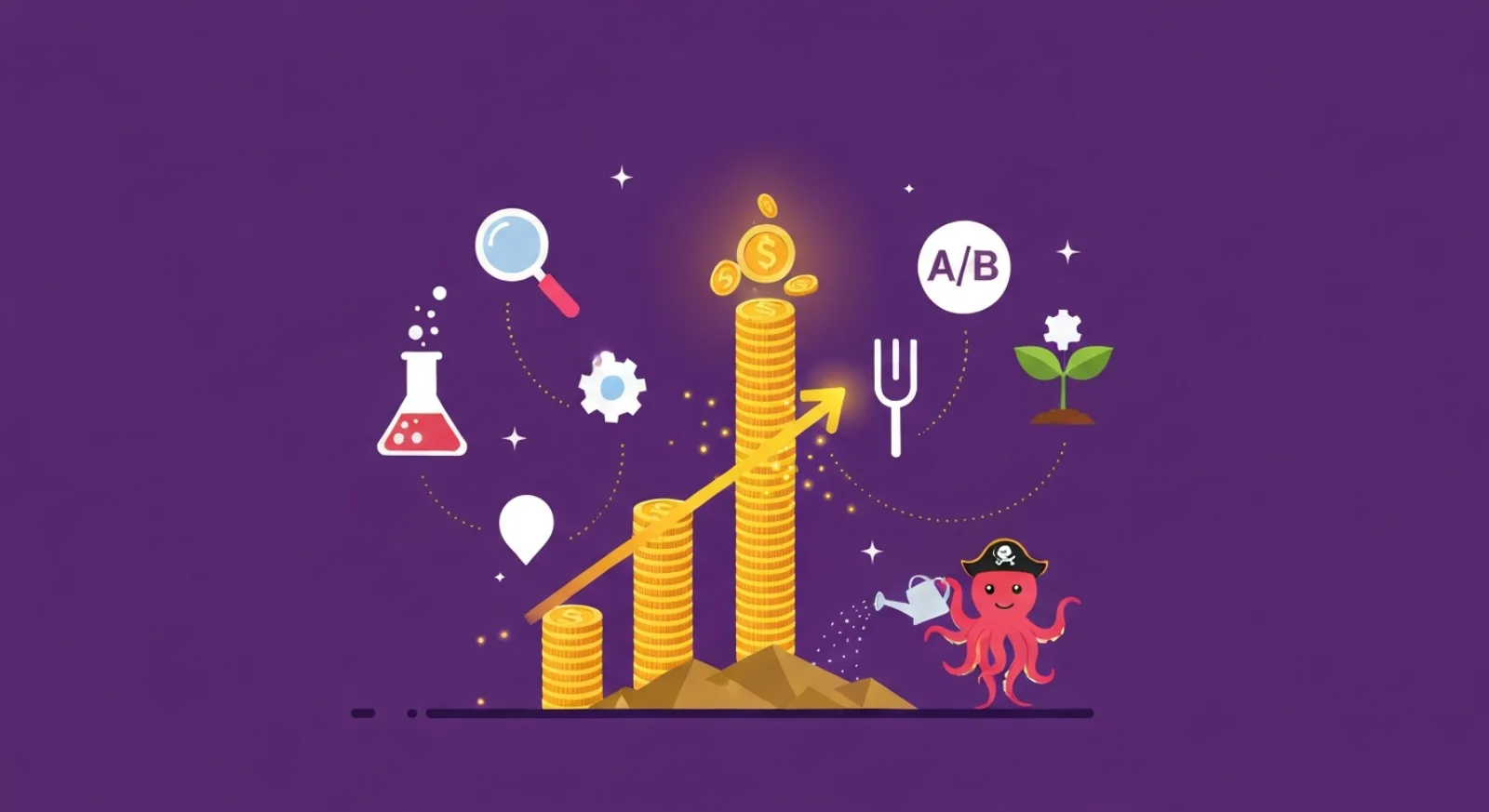
The first 90 days after an acquisition are about observation and stabilisation — don't break what you just bought. But month 4 onwards? That's when the real work begins.
The mistake most first-time acquirers make is treating year 1 as a long stabilisation period. They run the business as-is, wait for something to go wrong, fix it, and declare success. Meanwhile, the business is flat, the multiple they paid starts to look stretched, and the seller's trailing 12-month numbers are looking better than the new 12-month numbers.
The antidote is a structured experimentation backlog. Not 40 wild swings — 10 experiments, ranked by ease and upside, executed sequentially so you never have two major unknowns running at the same time.
Here's the playbook.
Why Year 1 Is the Best Time to Experiment
Counter-intuitive, but true: the first year after acquisition is when your risk tolerance for growth experiments is *highest*.
- You haven't optimised the business yet, so baseline conversion rates, average order values, and churn rates likely have obvious room for improvement.
- You have fresh eyes — the previous owner was blind to low-hanging fruit they'd stopped seeing.
- You're mapping everything anyway (tech stack, customer base, traffic sources), so the data cost of adding experiments is low.
- Any wins you log now compound over the remaining hold period.
Start with the lowest-effort, highest-certainty experiments. Save the high-effort, high-uncertainty bets for year 2 once you understand the levers.
The 10 Experiments, Ranked by Effort
1. Fix the Three Cheapest CRO Wins
Before running paid traffic to anything, fix the conversion floor. Audit your most-visited pages with a heatmap tool (Hotjar, Microsoft Clarity — both have free tiers). Look for:
- CTA buttons below the fold with no above-fold anchor
- Product/service pages with no social proof (reviews, testimonials, trust badges)
- Form fields asking for data that's optional and reduces completion rates
Typical lift: +5–15% conversion rate on the pages you fix. Timeline: 2 weeks.
2. Launch an Email Capture + Welcome Sequence
If the previous owner wasn't capturing emails aggressively, you're sitting on a long-term asset that compounds for free. Add a lead magnet (checklist, guide, discount) to the highest-traffic pages. Set up a 3-email welcome sequence that delivers the lead magnet, demonstrates value, and makes a soft CTA.
Email is the one channel you own. It doesn't have platform risk. Typical lift: 10–20% of cold email traffic can be re-engaged within 6 months. Timeline: 3 weeks to build.
3. Test a 10% Price Increase
This is the most feared experiment on the list and the one with the fastest ROI. Most online businesses are underpriced relative to the value they deliver. A 10% price increase with zero change in conversion rate = 10% more revenue. If conversion drops by 5%, you're still net positive.
Start with new customers only. Measure for 30 days before rolling out to returning customers. For SaaS, test on new plan signups only before touching existing subscribers.
Typical lift: 6–12% revenue increase with minimal volume drop. Timeline: 4 weeks.
4. Reactivate Dormant Customers
Customers who bought 6–18 months ago and went quiet are your cheapest leads. They already know you, already trusted you once, and need far less convincing than cold traffic. Pull a segment of customers with at least one purchase but no activity in the last 90 days. Send a 3-email winback sequence (something changed, here's what you missed, here's an offer).
For SaaS: focus on churned users who were on paid plans. For e-commerce: users who bought once and never returned.
Typical lift: 5–15% of dormant customers re-engage. Timeline: 2 weeks.
5. Add One Upsell or Cross-sell at Checkout
A single well-placed upsell — "customers who bought this also bought X" or "upgrade to the Pro tier for $Y more" — is the fastest way to increase average order value without touching your traffic. One-click upsells at checkout or in the post-purchase email can add 15–30% to AOV with the right offer.
Rule: the upsell should be lower friction to say yes to than no to. If it requires a separate signup, credit card entry, or complicated setup — save it for later.
Typical lift: +15–25% AOV. Timeline: 3 weeks.
6. Fix the Top 3 SEO Content Gaps
Pull a keyword gap analysis between your domain and the top two competitors (Ahrefs, SEMrush, or even a free tool like Ubersuggest). Find informational keywords in your niche that you don't rank for and that have clear buying intent downstream.
Write 3 posts in 6 weeks. Optimise existing posts that rank on page 2 (positions 11–20) by extending content and fixing internal linking. Don't try to fix 30 posts — fix the 3 that have the most movement potential.
Typical lift: +10–20% organic traffic in 6–9 months. Timeline: 6 weeks.
7. Activate Cart Abandonment (E-commerce) or Trial Expiry (SaaS)
If you're running e-commerce and don't have a cart abandonment email sequence, you're leaving 70% of nearly-completed purchases on the table. A simple 3-email sequence (reminder at 1h, urgency at 24h, discount at 48h) typically recovers 5–15% of abandoned carts.
For SaaS: a trial-to-paid upgrade sequence triggered 3 days before trial expiry, at expiry, and 7 days after expiry. Address the most common objection in each email.
Typical lift: +5–15% recovered transactions. Timeline: 2 weeks.
8. Expand Distribution by One Channel
Your business currently has 2–3 traffic sources. Add one new one — but only one, and only after the above experiments are in place. Options by business type:
- Content site: YouTube channel summarising your top-performing articles. Redirects back to the site.
- E-commerce: Pinterest shopping, TikTok product videos (organic, not paid).
- SaaS: ProductHunt relaunch, integration marketplace listing (Notion, Zapier, Shopify App Store).
One channel. Measure for 60 days. Decide if it's worth doubling down.
9. Launch a Referral or Affiliate Programme
Your existing customers are your best salespeople, and they'll work for a discount or a commission. Even a basic referral programme (give $20, get $20) can create a compounding acquisition loop.
For SaaS: look at tools like ReferralHero or Rewardful. For e-commerce: Shopify has referral apps built in. Don't over-engineer the structure — flat discounts work fine to start.
Typical lift: 10–20% of new customers from referrals within 12 months of launch. Timeline: 3 weeks to set up.
10. Bundle Two Existing Products or Tiers
Bundles increase perceived value without increasing cost of goods. If you have two products or services that customers frequently buy together, offer them as a bundle at 15–20% below the sum of their parts.
For SaaS: Annual plan at a 2-month discount. For e-commerce: starter kit bundles. For content sites: course + community combo.
Bundles also simplify the buying decision — fewer options, less hesitation.
How to Prioritise
Don't run all 10 at once. The order above is roughly right for most businesses:
- 1. Months 1–3: Experiments 1–4 (CRO fixes, email capture, price test, winback). Low risk, fast feedback.
- 2. Months 4–6: Experiments 5–7 (upsell, SEO gaps, abandonment). Moderate effort, reliable payoff.
- 3. Months 7–12: Experiments 8–10 (new channel, referral, bundle). Higher effort, requires data from earlier experiments.
Never run two major variables simultaneously. You'll lose the ability to attribute results.
Where to Find Your Next Deal
Once you've proved these experiments work, you'll want to apply them to your next acquisition. Browse deals on Flipagora to see aggregated listings across Empire Flippers, Flippa, and more. Set up deal alerts so you get notified when a business matching your criteria hits the market.FAQ
When is the right time to start experimenting — month 1 or month 4?
Start observations immediately (month 1) but don't ship experiments until you have 30 days of clean baseline data. Experiments 1–4 (CRO, email, price, winback) can typically start in month 2. Major channel expansion should wait until month 7+.
What if the previous owner already tried some of these?
Ask during due diligence. If they tried price increases and saw severe churn, that's important signal. Get their data before you assume you know better. Seller insight on what they tried — and why they stopped — is one of the most underrated parts of transition documentation.
How do I know if an experiment worked?
Define your success metric *before* you start: conversion rate, revenue per session, churn rate, AOV. Set a minimum detectable effect (MDE) and minimum run time. Don't stop an experiment because it looks like it's working at day 5 — statistical noise is loudest early.