The Deal Structure Question Most Buyers Never Ask
You've found a listing that checks every box — clean revenue, a defensible niche, a seller who answers questions fast. So you move straight to price and terms. But before you get there, there's a structural question that quietly shapes almost every other clause in the deal: are you buying the business's assets, or are you buying the legal entity that owns them?
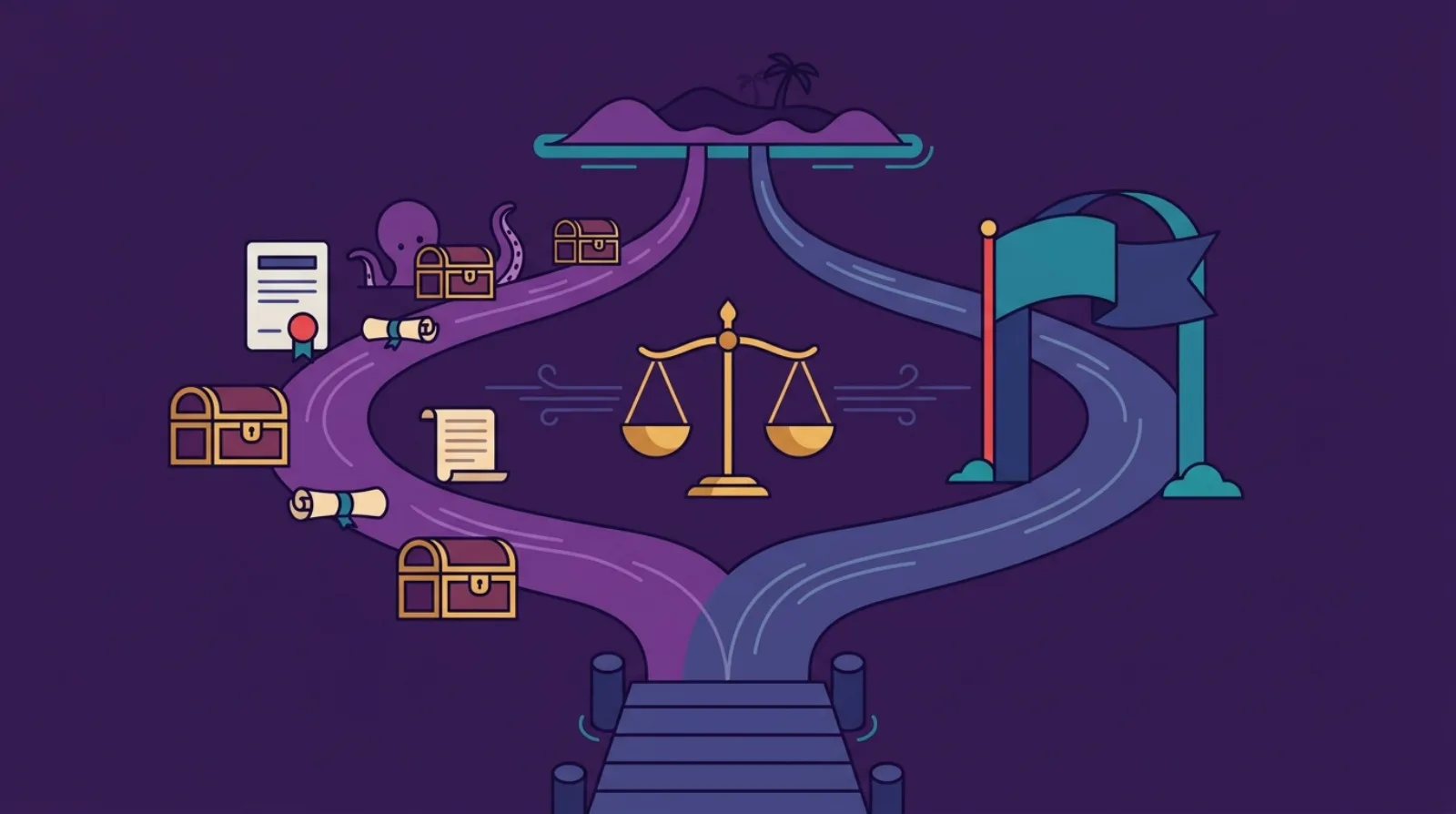
Flipagora surfaces listings from Empire Flippers, Flippa, and a handful of other marketplaces every day, and the overwhelming majority of them — SaaS tools, content sites, e-commerce stores, apps — close as asset purchases, not entity purchases. Most first-time buyers don't realize there's a choice at all, let alone that the choice changes what you're liable for, how you're taxed, and what actually transfers on closing day. Think of this as Flippy's map of the two routes into port — and why one of them is almost always the safer harbor for a marketplace-sized deal.This isn't legal or tax advice — deal structure has real, business-specific consequences, and you should run your specific situation past a lawyer or accountant before you sign anything. What follows is the framework to understand before that conversation, so you walk in asking the right questions instead of learning the difference the hard way.
What an Asset Purchase Actually Means
In an asset purchase, you're buying a defined list of things — not the company itself. For an online business, that list typically includes the domain, the codebase or theme/plugin files, content and media assets, the customer or email list, brand assets and trademarks, supplier or vendor agreements the seller assigns to you, and sometimes select social accounts. What you're explicitly *not* buying is the seller's legal entity — its history, its other obligations, its unrelated liabilities.
That last point is the whole appeal. If the seller's LLC has a dispute with a former contractor, a tax question from two years ago, or a lawsuit brewing over something unrelated to the asset you want, an asset purchase generally lets you leave all of that behind. You list exactly what you're acquiring in the purchase agreement, and anything not on that list stays with the seller.
What a Stock or Equity Purchase Means
A stock (or membership-interest, for an LLC) purchase is different: you're buying the entity itself, in its entirety. Every contract, every liability, every piece of history the company has ever accumulated comes with it, whether you knew about it or not. The seller's company simply changes owners — you step into their shoes completely.
For a marketplace-sized digital acquisition, this is far less common, but it does happen, and understanding when helps you recognize it if it comes up in your own deal.
Why Almost Every Marketplace Deal Is an Asset Purchase
A few reasons this structure dominates in the online business world specifically:
- Liability containment. Buyers of small and mid-sized digital businesses want the upside without inheriting unknown legal or financial exposure. An asset deal draws a hard line around exactly what you're taking on.
- Cleaner tax position. Buyers generally get a "stepped-up" basis in the assets they acquire, which can mean more favorable depreciation and amortization going forward — a meaningful factor for anything with real IP or content value.
- Simplicity at small scale. Below roughly the seven-figure mark, most sellers don't have complex corporate structures worth preserving, so there's little upside to buying the entity instead of the assets.
- Marketplace norms. Brokers and platforms that list online businesses have largely standardized around asset purchase agreements because they're faster to close and easier for both sides to understand without extensive legal review.
Asset Purchase vs. Entity Purchase, Side by Side
| Factor | Asset Purchase | Stock / Entity Purchase |
|---|---|---|
| What transfers | Only the listed assets (domain, code, content, customer list, etc.) | The entire legal entity, including unlisted liabilities |
| Liability exposure | Limited to what's explicitly assumed | Buyer inherits all past and pending liabilities |
| Tax basis for buyer | Stepped-up basis on acquired assets | Buyer inherits seller's existing basis |
| Typical use case | Marketplace-sized SaaS, content, e-commerce, and app deals | Larger deals, or when platform accounts/contracts can't be reassigned |
| Deal complexity | Lower — a defined asset list and one agreement | Higher — full corporate and legal due diligence required |
| Speed to close | Generally faster | Generally slower |
When an Entity Purchase Actually Makes Sense in a Digital Deal
There are real scenarios where buying the entity — not just the assets — is the better or only workable path:
- Non-transferable platform accounts. Some marketplace or ad-platform accounts (certain payment processor relationships, ad accounts with long approval histories, or seller accounts tied to a specific business entity) are difficult or impossible to reassign cleanly. Buying the entity that holds the account can be the only way to preserve that history and avoid a cold-start review.
- Bundled products under one holding company. If you're acquiring a portfolio — several SaaS tools or sites owned by the same LLC — and you want all of them, buying the entity can be simpler than negotiating separate asset agreements for each.
- Seller tax preference as a negotiating chip. Sellers sometimes prefer stock sales for tax reasons. If the price reflects that preference favorably enough, it can be worth structuring the deal that way — with proportionally deeper due diligence to compensate for the added risk.
In every one of these cases, the tradeoff is the same: more of the seller's history transfers with the business, so your due diligence needs to go deeper before you agree to it.
Risks to Watch For, Whichever Structure You Choose
- Successor liability in disguise. Even in an asset deal, some jurisdictions and contract terms can expose a buyer to certain seller liabilities — unpaid taxes or specific "bulk sale" rules, for example. This is exactly the kind of detail a lawyer should check for your jurisdiction before closing.
- Non-assignable contracts. Some vendor agreements, API licenses, or SaaS reseller contracts explicitly prohibit assignment without the counterparty's consent. Confirm early which of the seller's key contracts actually transfer — don't assume a signature on the purchase agreement is enough.
- Unresolved customer or platform disputes. Open chargebacks, pending platform policy reviews, or unresolved customer complaints can follow the business in ways that aren't always obvious from a quick look at the numbers.
- Vague or missing asset lists. A short, casual asset list is a red flag in itself. A serious seller should be able to hand you a specific, itemized list of exactly what transfers — down to which social accounts and domains are included.
Getting This Right Before You Sign a Letter of Intent
Deal structure isn't something to leave until the closing documents. Raise it early — ideally before you put an offer in writing — so it doesn't become a late-stage surprise that stalls negotiations. Ask the seller directly whether they're expecting an asset sale (the default for most marketplace deals) or something else, and why. If the answer is vague, treat it as a signal to dig deeper before you move forward.
Ready to see how sellers structure real listings? Browse deals across marketplaces, check out current Empire Flippers deals or Flippa listings, and set up deal alerts so you catch well-documented listings — the kind where the seller has already thought through exactly what you're buying — as soon as they go live.Frequently Asked Questions
Is an asset purchase always safer for the buyer?It's generally lower-risk for marketplace-sized deals because it limits what liabilities transfer, but "safer" still depends on the specific asset list, the jurisdiction, and how carefully the agreement is drafted. A narrow, well-documented asset list is what actually creates the protection — not the label "asset purchase" by itself.
Can a deal be structured as a mix of both?In practice, most marketplace deals are asset purchases, but larger or more complex deals sometimes combine elements — for example, acquiring the entity while carving out specific liabilities in the purchase agreement. This is squarely legal-advice territory; loop in a lawyer if your deal looks like it might need this kind of structure.
Does deal structure affect how I pay — cash, financing, or an earnout?Not directly, but it can affect the sequencing. Lenders and escrow providers may ask which structure you're using, since it changes what collateral or liability they're underwriting around.
Where should deal structure show up first in the process?Ideally in your letter of intent, once you've decided in principle, so both sides are negotiating price and terms with the same structure in mind rather than assuming different things.
Key Takeaways
- Almost every marketplace-sized online business deal closes as an asset purchase, not an entity purchase — know which one you're being offered.
- Asset purchases limit what liabilities transfer to you and generally offer a cleaner tax position through a stepped-up basis.
- Entity purchases make sense mainly when platform accounts or bundled products can't be cleanly split into an asset list.
- Whichever structure you use, confirm which contracts are actually assignable and get a specific, itemized asset list before you sign.
- Raise deal structure early — before your letter of intent — so it never becomes a late surprise.